


 Shop
Shop nearpeer.org
The Real Reason CSS 2026 Felt Tough for Aspirants
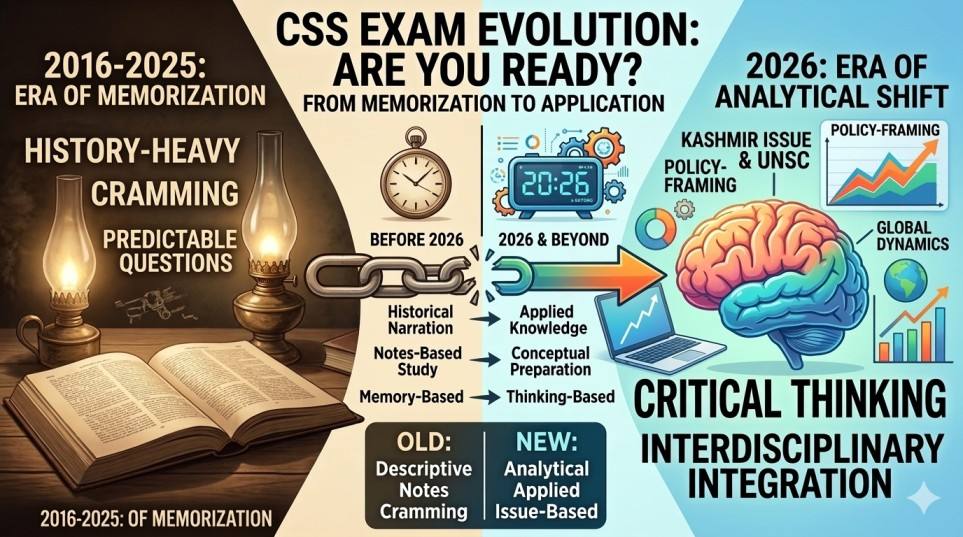
Many aspirants have called the CSS 2026 papers “tough,” “unexpected,” or even “out of syllabus.”
But the real question is: Were they truly difficult, or were they testing something different?
If we examine the trend from 2016 to 2026, a clear structural evolution emerges.
2016–2025: The Era of Historical and Descriptive Questions
During this period, CSS papers were largely predictable. Questions focused on causes, impacts, importance, and critical evaluation — all within familiar themes. Aspirants relied on:
- Historical narration
- Chronological clarity
- Balanced arguments
- Quoted references
Smart cramming worked. Prepared notes worked. Repeated themes with slightly altered wording were common. Success depended on memory, not critical thinking.
2026: The Analytical and Applied Shift
In 2026, a transitional change became evident. Questions began linking historical knowledge with present realities. Aspirants were now asked to:
- Justify arguments
- Suggest measures
- Evaluate institutional roles
- Integrate governance and economic dimensions
Facts alone were no longer enough. Contemporary relevance and policy framing became essential.
For instance, a question like:
“The unresolved Kashmir issue exposes inherent weaknesses in the UNSC architecture. Critically examine.”
This is not just about narrating history. It requires:
- Understanding institutional design
- Veto politics and power asymmetry
- Realism vs. liberalism
- Global multipolar dynamics
- Application to Pakistan’s context
Similarly, a question on Afghanistan demanded insights into security dilemmas, spillover effects, regional diplomacy frameworks, and internal security implications.
Key Changes in CSS 2026
- Statement-based, argumentative questions replaced direct prompts. Candidates must take a stance and demonstrate intellectual maturity.
- Theory application is now mandatory. Memorized definitions without context are irrelevant.
- Multipolar world perspective dominates, with emphasis on China’s rise, regional blocs, and Pakistan’s role.
- Historical narration decreased — focus is on “why it matters” rather than “what happened.”
- Interdisciplinary integration is required: political theory, international relations, governance, economics, and institutional critique.
Why Did Aspirants Find It Difficult?
Because most preparation still relied on:
- Notes-based study
- Academy-dependent guidance
- Prediction-focused strategies
- Memorized outlines
The examiner, however, tested thinking, not memory.
The Structural Reason Behind the Shift
CSS recruits for policy-level roles. The state needs analysts, strategists, and decision-makers — not historians. With easy access to information via lectures, PDFs, and AI tools, memorization no longer differentiates candidates. Intellectual application does.
The New Preparation Model
- Strong conceptual foundations in political theory, IR frameworks, governance models, economic stabilization, and constitutional principles.
- Issue-based preparation instead of topic-based: water security, civil-military relations, institutional crises, economic sustainability, regional connectivity, identity politics, and security paradigms.
- Argument-building practice: Every answer must take a stance, apply theory, integrate global context, connect to Pakistan, and suggest practical reforms.
The Structural Evolution👇
| Year Range | Focus | Preparation Strategy | Outcome |
| 2016–2025 | Descriptive, history-heavy | Cramming effective | Memory-based success |
| 2026 | Analytical, applied, contemporary, interdisciplinary | Conceptual + applied | Thinking-based success |
CSS is no longer about how much you know. It is about how effectively you can apply what you know. CSS 2026 was not impossible.It demanded intellectual maturity. Aspirants who read critically, connect theory with current developments, practice analytical writing, and frame Pakistan within global transitions will be ready for future papers.
The Exam Has Evolved — Preparation Must Evolve Faster👇
For guidance on the new preparation approach, WhatsApp us at 0311-1444734.
Written By muqadas admin Mar 6, 2026


